











ByteDance and Tencent Intensify AI Talent Competition Amid DeepSeek Poaching Reports
Competition for top AI researchers in China is intensifying, with reports that ByteDance recruited DeepSeek’s lead R1 researcher Guo Daya for an annual salary of up to 100 million yuan. ByteDance denied the reported compensation figure but did not confirm or deny the hire. The move, if confirmed, would highlight the growing willingness of Chinese tech firms to pay aggressively for talent as the AI race accelerates. Companies are increasingly poaching from domestic rivals as well as recruiting from Silicon Valley.
Chinese Robot Beats Human World Record at Beijing Half-Marathon
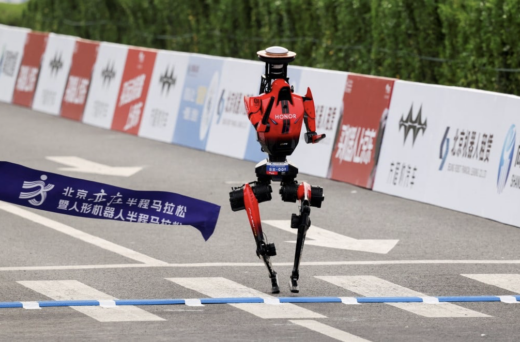
A humanoid robot called Lightning, developed by Chinese smartphone maker Honor, won Beijing’s second annual robot half-marathon with a finishing time of 50 minutes 26 seconds — more than six minutes faster than the human world record and 17 minutes ahead of the quickest human in the same race. The event attracted 105 robot competitors, up from 21 the previous year, with nearly 40% running autonomously, including the top three finishers. Not all robots completed the course without incident — one collapsed near the finish line and another hit a barrier. China currently accounts for 80% of the global humanoid robot market.
Amazon Opens China Logistics Hub to Cut Shipping Times and Counter Rivals
Amazon has officially opened its first Global Warehousing and Distribution facility in Shenzhen, China, combining storage and customs clearance into a single step to streamline cross-border shipping for sellers. The move reduces shipping times from as long as four weeks to as little as three days, according to early participants. The facility reflects Amazon’s effort to deepen ties with Chinese suppliers amid intensifying competition from Temu and Shein, which have built their models around direct-from-China shipping.
Microsoft Floats Idea of Selling Software Licenses to AI Agents
A Microsoft executive has suggested that AI agents could be treated as individual software users, each requiring their own license or “seat” — a model that could expand rather than shrink enterprise software revenue. The idea comes as investors worry that AI will reduce the number of human employees needing software subscriptions, undermining the seat-based pricing model that underpins companies like Microsoft, Salesforce, and Workday.
Google to Penalize Sites That Hijack the Browser Back Button
Starting June 15, 2026, Google will treat back button hijacking as a malicious practice, with affected sites facing lower search rankings as a penalty. Back button hijacking occurs when a website manipulates browser history to redirect users to another page instead of the one they came from, typically to generate additional pageviews. Google says the practice creates a deceptive user experience and is on the rise. Sites have until the deadline to remove the behavior, whether it originates from their own code or a third-party library.

France Moves to Replace Windows with Linux Across Government
France’s Interministerial Directorate for Digital Affairs has formally announced a shift away from Windows on government workstations, with individual ministries required to develop migration plans by fall 2026. The transition is expected to be based on GendBuntu, a Linux distribution already running on over 100,000 machines in France’s national police force for nearly 20 years. The move is framed as a matter of digital sovereignty, with France also mandating that civil servants replace Microsoft Teams and Zoom with domestically built alternatives by 2027.
Stanford Report: China Has Nearly Closed the AI Gap with the US
A 2026 Stanford HAI report found that China has nearly eliminated the US lead in AI model performance, with the gap in Arena scores between the top US and Chinese models shrinking from over 300 points in 2023 to just 39 points by March 2026. China also leads the world in AI patents, research citations, and industrial robot installations. Meanwhile, the flow of AI talent into the US has dropped 89% since 2017, accelerating sharply in the past year. US private investment in AI still far exceeds China’s at $285.9 billion versus $12.4 billion, but analysts point to China’s energy infrastructure advantages and growing domestic talent base as structural advantages in the longer-term competition.